Arms Race 2.0: Why Speed, Not Strategy Papers, Will Decide Europe’s Security
In war, the side that learns faster wins, not the side that plans longer. This has been true since Sun Tzu and remains true in AI-enabled conflict.
THE PROBLEM
We are living and witnessing “the Arms Race 2.0” (RO: Cursa înarmărilor 2.0) which isn’t a simple replay or continuation of the Cold War, but rather an ongoing contest of readiness, technology, and speed.
Across multiple security/defense panels I’ve joined over the past few months, the message from European military, policy, and industry leaders has been consistent: Europe must protect itself and build credible defense capabilities, not just talk about them. The era of relying on others for security has effectively ended (attention: I am not vouching for non-cooperation with our American allies nor do I think NATO is going to hell).
That truth hits the core of Europe’s defense challenge:
-
Europe defense still depends heavily on the U.S.
The United States accounts for roughly 62 % of NATO’s total defense spending, which is visibly a larger share than all other members combined. For decades, many European countries budgeted far less than the NATO guideline of 2% of GDP on defense; only in recent years has this improved, and even then the gap in capabilities remains wide. American systems still fill a large portion of European arsenals, in some cases nearly two-thirds of arms imports to European NATO forces are U.S.-made. To that we say: let’s commence the talk about operational independence already because relying on American technology, logistics, and strategic guarantees does leave Europe vulnerable to shifts in U.S. policy (stark relief in recent years).
-
European spending is increasing, but still too slow
Collective EU defense spending rose sharply over the last decade, with member states projected to spend around €381 billion in 2025, up more than 60 % since 2020. Yet, even with this growth, European military investment and production remain fragmented. A recent European Defence Agency (EDA) analysis found that, collectively, EU nations spend roughly one-third of what the U.S. does but possess only a fraction of the operational capability.
-
The NATO spending debate is real and consequential
Europe can no longer assume the security framework of the past will automatically hold, nor that others will always be willing or able to fill capability gaps. That being said, under pressure from Washington, NATO has discussed ambitions and commitments to increase defense spending targets with proposals discussed of up to 5 % of GDP in total defense and related security expenditures by the alliance.
- In panels from Davos to Brussels, the refrain from European defense professionals has been clear: we must build our own capacity,
- invest in interoperable and rapidly deployable systems, and
- innovate at speed.
=> Europe’s security is based on shared political & financial will.
SOLUTIONS?
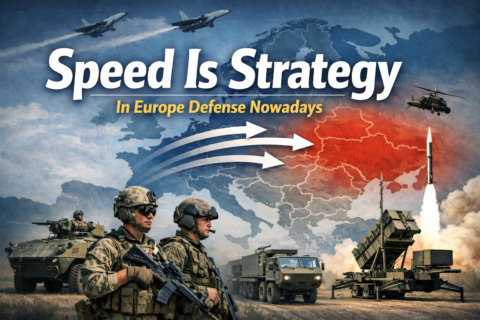
Speed Is Strategy
In modern conflict, time is one of the most precious resource. Long funding cycles are not just inefficient, they are strategically dangerous. Deterrence depends on credibility, and credibility depends on the ability to deliver capability before a crisis matures.
Roman Vybranovskyy, Co-founder, Ukraine Facility Platform (UAFP) brought the conversation back to reality shaped by war. In Ukraine, time is the most expensive resource. Innovation cycles measured in months simply do not survive contact with the enemy. “Eight to ten months to fund defense innovation, that’s an eternity. And if we are hit tomorrow… what exactly is NATO?”.
Military history has always rewarded logistics over symbolism. Today it’s no different, but we also reward manufacturing depth, software-defined systems, and interoperable standards. Fragmentation and overregulation on that end weakens Europe more than any external adversary. This is why the fixation on perfect, bespoke platforms is misplaced. What matters is deployable, scalable systems that can be fielded, iterated, and replaced quickly.
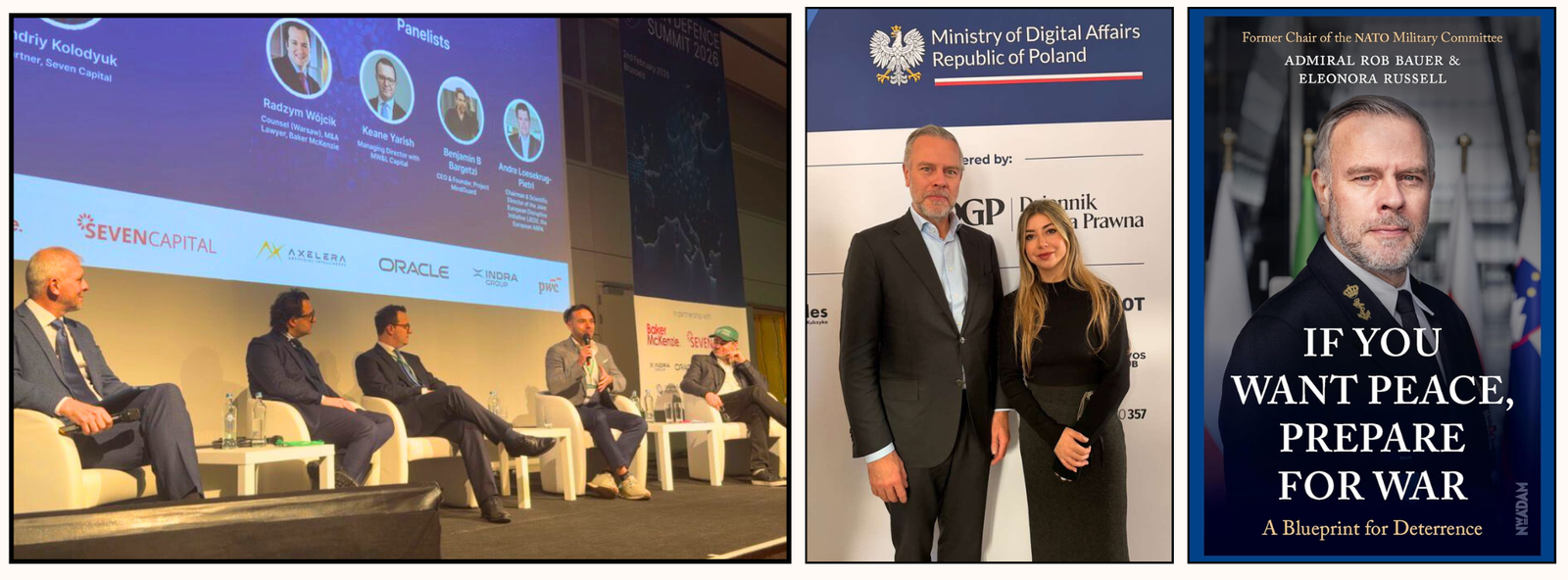
As André Loesekrug-Pietri put it bluntly last Monday, Feb 2nd, on the stage of AI for Defense Summit in Brussels, “We need speed and good enough for Europe, not luxury and haute couture.”
Brooks Newmark, Former Minister for Civil Society, United Kingdom, also urged the message to “Stop talking. Start acting.” at the same event. The message was direct and necessary. Words without execution are a liability. Modern conflict is no longer confined to the battlefield. We are already engaged in hybrid warfare: psychological, informational, cyber, economic, long before the first kinetic strike.
Europe must move beyond defensive posture and embrace a more proactive, assertive approach, including:
- information operations (INFO OPS),
- strategic influence,
- and readiness for escalation across non-kinetic domains.
Waiting to respond is no longer a strategy.
Europe’s Defense Capital Paradox
Europe is not poor. It is constrained by its own rules.
ON PUBLIC FUNDS:
Giedrimas Jeglinskas, Member of Parliament, Lithuania and former NATO official, states: “€150 billion is available for defense lending. €33 trillion is sitting idle in EU savings.” Jeglinskas pointed to a structural contradiction at the heart of Europe: massive pools of capital exist, largely in pension and savings funds, yet regulatory barriers prevent this capital from being mobilized for defense. Until this changes, Europe will continue to debate strategy without financing its own security. Readiness is not only military, it is actually mostly financial and regulatory.
(Background: The European Union has activated the Security Action for Europe (SAFE) programme, providing €150 billion in loans for member states to boost defence readiness and joint procurement by early 2026. This €150 billion, designed for rapid investment, was fully subscribed by 19 member states in August 2025, with plans to support Ukraine and strengthen the European defense industrial base. More updates & information here)
ON PRIVATE FUNDING:
“When you invest in defense, you invest in your own security.” Dmytro Kuzmenko, Ukrainian Venture Capital & Private Equity Association (UVCA).
The Ukrainian paradigm is now turning old assumptions upside down. Where defense was once avoided by capital, today capital is actively seeking it.
The paradox?
- Investors are ready to deploy funds.
- Some defense companies are now intentionally refusing capital.
- Investors are hunting unicorns / constantly looking for ‘hidden gems’. What does that mean? A combo of agile teams, dual-use tech, fast-learning systems. The question is whether Europe’s industrial base is ready to absorb this moment.
Process over product
One of the most important refrains this year was simple and radical: Stop fetishizing the product. Fix the process. The real competitive edge in modern military power is not who builds the most exquisite system, but:
- who innovates fastest,
- who deploys quickest,
- who adapts under pressure.
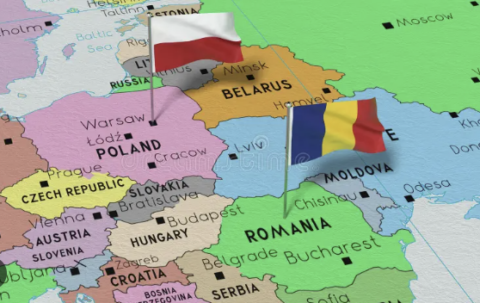
“Capability delivery beats capability perfection.” Robin Wood Sailer, General Partner at Helena Capital and co-founder of Le Labs. During the panel at WEF, Robin underscored the geopolitical map behind innovation, highlighting Poland as a critical strategic and industrial node for Europe, a place where urgency, geography, and political will intersect.
*Personal note. This prompts me to a wider reflection: with a similarly sensitive geostrategic placement and exposure to risk, how does Romania define its own strategic posture? (I must unpack in a subsequent post.)
As a final message, „Europe needs to get out of bed / (and to) Stop getting distracted.” – as put at the House of Poland Fireside Chat on „Leadership and strategy in a changing security landscape”, during WEF 2026, by Admiral (ret.) of Royal Netherlands Navy, Robert Bauer, also former Chair of the Military Committee of NATO and author of the book “If You Want Peace, Prepare for War: A Blueprint for Deterrence” which can be ordered here.
The future of European security will be decided by those who can convert capital into capability, process into speed, and get consensus into action. Defence is THE operating system for sovereignty.